Emergency fire services
Are you ready to make an impact at the Stark State fire academy? Gain the knowledge, skills and state certifications you need to become a confident, capable and compassionate first responder.
Program at a glance
DEGREE TYPE
Associate of Applied Science
PROGRAM FORMAT
In person, hybrid
LENGTH (FULL TIME)
4 semesters
CAREER COMMUNITY
Human services, social services and public safety
Note: Many Stark State classes have online and in-person options, including required general education courses.
Program overview
Stark State College’s firefighter program prepares you for a successful career in emergency fire services.
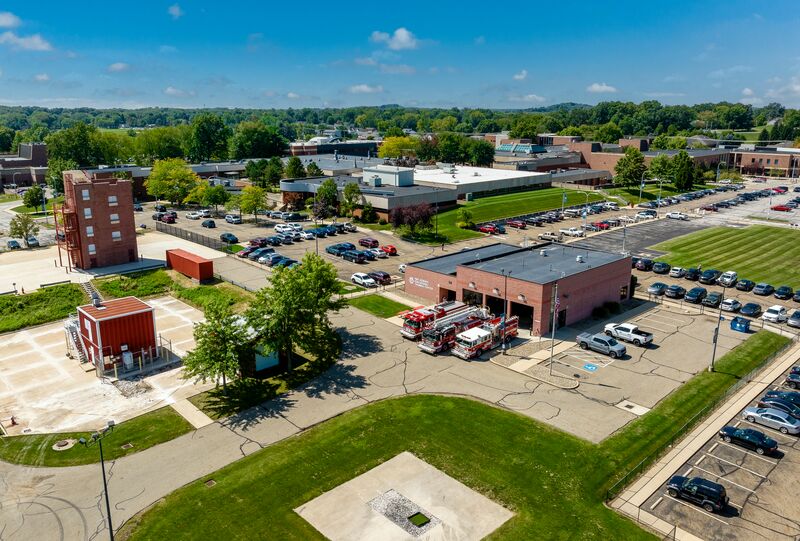
Our Ohio fire academy combines the best in classroom learning, hands-on training and real-world experience. Whether you’re just starting out or looking to advance in the fire service, you’ll find a comprehensive degree pathway that fits your career goals.
Prepare. Train. Serve.
Program details
From best-in-class instructors to hands-on instruction, the Stark State fire academy delivers the most thorough first-responder training in northeast Ohio.
Our program includes firefighter level I and II certification courses —credentials required for professional firefighting in Ohio. These courses lay the groundwork for handling a wide range of emergency situations and build the core competencies every firefighter needs.
Learning goes far beyond the classroom. You’ll build real-world firefighter skills through live, hands-on training, including:
- Fire apparatus operations. Learn how to operate fire engines, pumps, ladders, hoses, and other essential tools and vehicles.
- Live fire training scenarios. Gain valuable experience in our state-of-the-art burn building and on multiple live fire training props. You’ll learn how to assess and respond to active fire environments in a safe, controlled setting.
- Team-based field exercises. Strengthen your leadership, communication and collaboration skills, which are crucial for working in high-stress emergency response teams.
At Stark State, every instructor at our Ohio fire academy is a current or former member of the fire service. They bring real-world insight, firsthand experience, and a deep passion for mentorship. You’ll train alongside peers who share your dedication, in an environment that fosters discipline, teamwork and mutual respect, values that are essential in emergency service careers.
The coursework not only meets certification standards but also develops well-rounded, knowledgeable professionals.
- Fire behavior and combustion
- Personal Protective Equipment (PPE)
- Water supply and fire attack
- Forcible entry, search and rescue
- Vehicle extrication
- Incident command systems
- Hazardous materials operations
- Firefighter survival techniques
Stark State College is accredited by the Higher Learning Commission. The emergency fire program is accredited by the Ohio Department of Public Safety Division of EMS #008 for firefighter education and follows the curriculum according to the Ohio Administrative Code 4765 for all levels of firefighters.
The fire service is a noble and gratifying career. Firefighters are called upon to respond to many different situations. The main goals of a firefighter are to save life, protect property, to render humanitarian and special services, and to safeguard the environment. On any given day a firefighter may be called upon to respond to structural fires, car fires, animal rescues, brush fires, hazardous materials incidents, water rescue, and more. Firefighters are confronted with challenging situations and must act quickly and decisively to mitigate these incidents to protect the public and themselves from harm. Firefighters are held in high regard by the public they serve.
According to various sections of the Ohio Law and Regulations for Certification and Licensure Boards, persons convicted of any felony will not be accepted into the emergency fire services and the emergency medical services programs at Stark State College. Persons convicted of a misdemeanor may not be accepted into the emergency fire services and emergency medical services programs at Stark State College. For more information, contact the Emergency Fire Services Program Coordinator.
To enroll in a firefighter course, a student must:
- Enroll in the College.
- Be age 17 AND in the last year of high school OR 18 and out of high school.
- Complete a BCI background check.
- Complete required health physical.
- Meet admission requirements as set forth in OAC 4765.
- Submit a firefighter application to the Department of Emergency Services.
Stark State College is accredited by the Higher Learning Commission. The emergency fire services program is accredited by the Ohio Department of Public Safety Division of EMS #008 and follows the national standard curriculum according to the Ohio Administrative Code 4765 for all levels of EMS providers.
The Paramedic Program of Stark State College is accredited by the Commission on Accreditation of Allied Health Education Programs (www.caahep.org) upon the recommendation of the Committee on Accreditation of Educational Programs for the Emergency Medical Services Professions (CoAEMSP).
Commission on Accreditation of Allied Health Education Programs
25400 US Highway 19 North, Suite 158
Clearwater, FL 33763
727-210-2350
www.caahep.org
According to various sections of the Ohio Law and Regulations for Certification and Licensure Boards, persons convicted of any felony will not be accepted into the emergency fire services and the emergency medical services programs at Stark State College. Persons convicted of a misdemeanor may not be accepted into the emergency fire services and emergency medical services programs at Stark State College. For more information, contact the Emergency Fire Services Program Coordinator.
Please be advised that this curriculum could change. Students are required to follow the program curriculum in effect when they begin taking technical courses, not when students are accepted to the College or program.
Careers and outcomes
When you graduate, you’ll be fully prepared to serve as a firefighter in:
- Municipal fire departments
- Private fire services
- Industrial or corporate safety teams
- Specialized rescue or hazardous response units
You also will gain a solid academic foundation if you want to pursue further education in fire science, emergency management or public safety leadership.
Stark State – State of Ohio firefighter certification test pass rates 2019-2022
| Certification year | Certification | Students eligible for certification | Students attaining certification | Certification rate |
|---|---|---|---|---|
| 2022 | Firefighter 1&2 | 72 | 69 | 96% |
| 2022 | Volunteer Firefighter | 25 | 23 | 92% |
| 2021 | Firefighter 1&2 | 60 | 58 | 97% |
| 2021 | Volunteer Firefighter | 26 | 26 | 100% |
| 2020 | Firefighter 1&2 | 76 | 74 | 97% |
| 2020 | Volunteer Firefighter | 25 | 21 | 84% |
| 2019 | Firefighter 1&2 | 74 | 72 | 97% |
| 2019 | Volunteer Firefighter | N/A | N/A | N/A |
FAQs
The estimated costs for the firefighter I and II program for the 2026-27 school year:
Yes. If you want to pursue further education in fire science, emergency management or public safety leadership, our emergency fire sciences program has transfer agreements with:
- Bowling Green State University
- Franklin University
- Division Chief Kerry Alan Ball Emergency Services Memorial Scholarship
- Dominion East Ohio Gas Endowed Scholarship
- Katy Hatton, AKA Sara Kaaikaula Endowment Scholarship
- Quincy McGuire Memorial Human and Social Services Endowed Scholarship
- Joan M. Picone Memorial Endowed Scholarship
- Stacie Cross Annual Paramedic Scholarship
- Eric and Monette Wiedlebacher Paramedic Scholarship
Take a look at our general information guidelines for students with current Fire, EMT or Paramedic certifications:
Students who are currently certified in any or all of the following can receive credit for these courses provided they meet all the requirements for graduation. Students must contact the department chair of emergency services before this process.
Courses
- Firefighter level I and II – 11 credits
- EMT – 7 credits
- Paramedic – 30 credits
*A maximum of 40 credit hours, including transferred credits from other institutions, may be used by a student toward completion of an associate’s degree.
Students must complete the following requirements at Stark State College:
- A minimum of 20 credit hours.
- Submit current copies of certifications or course completion in the technical areas in which they are seeking credit.
The specific areas of credit courses available in the technical portions of these two degrees are as follows:
Emergency fire services degree
Firefighter level I and II (FST228), EMT (EMS121), Paramedic (EMS122), (EMS124), (EMS221), (EMS223), (EMS222), (EMS224), (EMS225)
Emergency medical services degree
EMT (EMS121), Paramedic (EMS122), (EMS124), (EMS221), (EMS223), (EMS222), (EMS224), (EMS225)
These credits will be posted when all the requirements of attaining the degree(s) have been met and verified by the department chair of emergency services. Students may not post any failing grades in the major in which they are seeking an associate degree. Students must also maintain at least a 2.0 grade point average.
For additional information, contact the department chair of emergency services.
Related programs
Motivated to serve others and your community? The field of human and public services offers careers for people who want to make a real difference and help others live safer, easier and more fulfilling lives.
Lowest tuition around
Put your money toward your goals – not debt.
Stark State’s tuition costs up to 83% less than other area colleges and universities. Along with financial aid and scholarship opportunities, you gain the most value for your education without sacrificing quality.
Have a question or want more information?
We’re here to help. Complete the form below, and we’ll connect you with the information you need.
"*" indicates required fields
Scroll to section
Eric Dyrlund
Program Coordinator, Emergency Fire Services
330-494-6170 ext. 4956
John Edwards
Department Chair, Emergency Services
330-494-6170 ext. 4352
Take the next step
Whether you’re just starting out, making your college comeback or looking for a change, you belong at Stark State.