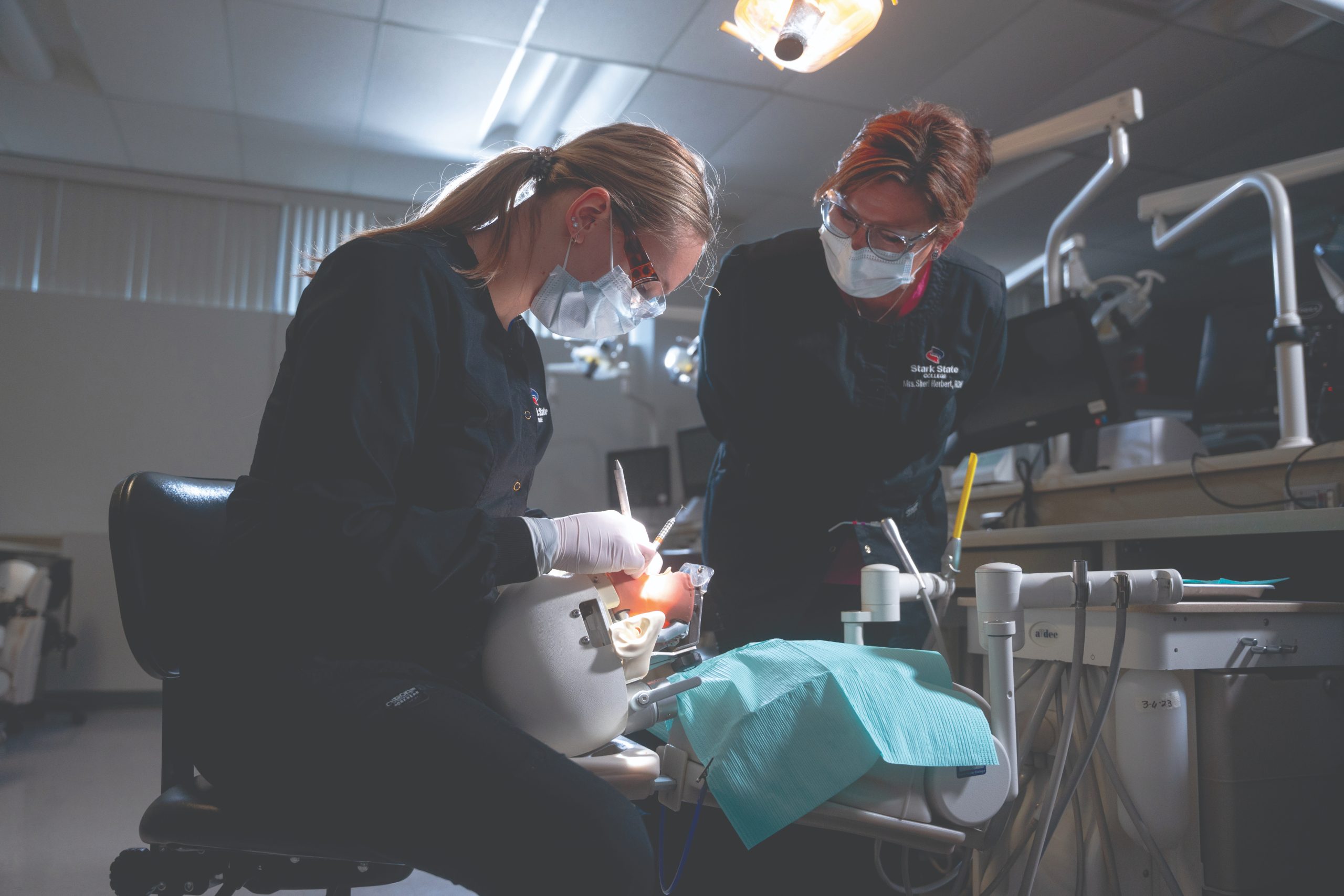
Medical assisting
Launch a rewarding career in healthcare with a medical assisting degree designed to put you at the heart of patient care. Our program bridges the gap between clinical expertise and administrative support, preparing you to become an important member of any medical team.
Program at a glance
DEGREE TYPE
Certificate
PROGRAM FORMAT
In person
LENGTH (FULL TIME)
3 semesters
Program overview
Be the physician’s right hand
As a medical assistant, you’ll help instruct and treat patients as well as handle the administrative procedures needed to keep an office running smoothly. Medical assistants are skilled in connecting with patients and other allied health professionals. You’ll likely work alongside physicians in outpatient or ambulatory care facilities, such as medical offices and clinics.
Program details
A medical assisting student at Stark State College completes a versatile curriculum that balances clinical skills —including phlebotomy, EKG monitoring and pharmacology—with administrative training in office procedures, insurance billing, and electronic health records. Your training will conclude with a practicum in real-world healthcare setting. This comprehensive approach ensures graduates are equally prepared to assist in hands-on patient care and manage the complex operations of a modern medical office.
- Apply to Stark State College.
- After all requirements have been completed, contact the Program Coordinator to schedule an appointment to start the application process: Program Coordinator:
Mirjana Ilijevski milijevski@starkstate.edu
330-966-5458 ext. 4515 - Contact SSC security to schedule your own BCI and FBI background checks. You will receive an email of verification of eligibility through your Stark State email. Please direct all background questions to the security office.
Students can finish the medical assisting certificate in just three semesters, becoming eligible to take the certified medical assistant – CMA(AAMA) – exam as well as the national exam to become a certified EKG technician.
All classes are held on Monday, Tuesday, Wednesday and Thursday each semester, with day or night programs available. Classes are eight weeks long. Cohorts begin in the fall on main campus and at Stark State Akron. Students are assigned to clinical sites for training.
Coming fall 2026 in the Mahoning Valley, in-person medical assisting cohort at Campbell City Schools Community Literacy Workforce and Cultural Center.
Please see the complete medical assisting estimated costs broken out here. Please keep in mind these costs are before any financial aid may be applied.
36 credit hours.
The last 210 hours of the last semester, the medical assisting students are assigned practicum at any of the local hospitals where the students will get hands-on, real life work experience.
There are 3 requirements for acceptance into the program: GPA of 2.0 or better, clean background check, and placement test score.
The Stark State medical assisting program is accredited for 10 years (2019-2029) by the Commission on Accreditation of Allied Health Education Programs (www.caahep.org) upon the recommendation of the Medical Assisting Education Review Board (MAERB).
Commission on Accreditation of Allied Health Education Programs
9355 – 113th St. N, #7709
Seminole, FL 33775
727.210.2350
Stark State College’s medical assisting program is located on main campus at 6200 Frank Avenue NW North Canton, OH 44720 as well as at Stark State College Akron, 360 Perkins St. Akron, OH 44304. 330-966-5458.
According to various sections of the Ohio Law and Regulations for Certification and Licensure Boards, persons convicted of any felony or a misdemeanor may not be accepted into a health program at Stark State College; may not be able to take the licensure or certification examinations; may be refused acceptance of placement by the clinical/practicum sites; or may have restrictions placed on their ability to practice. For more information, contact the dean of student services and the applicable licensure/certification board.
IMPORTANT: Felons are not eligible to sit for the examination unless the Certifying Board (CB) grants a waiver based on one or more of the mitigating circumstances listed in the disciplinary standards.
POLICY: STUDENTS SHALL NOT RECEIVE COMPENSATION/PAYMENT, MONETARY OR OTHERWISE, FROM THE PRACTICUM SITE. PRACTICUMS ARE REQUIRED FOR THE AAS DEGREE IN MEDICAL ASSISTING AND PHLEBOTOMY TECHNICIAN
Careers and outcomes
Medical assistants are in a high demand. They can work in hospitals, clinics, primary care offices, etc. Many of our graduates work in orthopedics offices, ambulatory care clinics, pediatric and OBGYN offices, and the major local hospitals like Akron Children’s, Summa, Aultman or Cleveland Clinic. Depending on the needs of the particular setting, you may work in an administrative (office) role, clinical role, or both.
On any given day, there are about 20-30 medical assisting openings in the local hospitals. Most of the students are offered a job while they are at their practicum site or as soon as they are done.
Administrative duties include:
- using computer applications including electronic medical record programs
- answering telephones and greeting patients
- updating and filing patient medical records
- coding and filling out insurance forms
- scheduling appointments
- arranging for hospital admissions and laboratory services
- handling correspondence, billing and bookkeeping
Clinical duties include:
- taking medical histories
- explaining treatment procedures to patients
- preparing patients for examination
- assisting the physician during exams
- collecting and preparing laboratory specimens
- performing basic laboratory tests
- instructing patients about medication and special diets
- preparing and administering medications as directed by a physician
- authorizing prescription refills as directed
- drawing blood
- taking electrocardiograms
- removing sutures and changing dressings
Medical assisting program outcomes
- 2020-2024: 5-year average for exam passage 78%
- 2019-2023: 5-year average for exam passage 77.55%
- 2022: Retention for medical assisting 70.37%
- 2021: Job placement for medical assisting 100%
- 2020: CMA exam passage 100%
FAQs
The average class size is 12 students, and the typical student-to-faculty ratio is 6 to 1.
No. The classes start in the fall, spring, and end with the summer semester.
Most of the classes are in-person, hands-on classes. There are 2-3 online classes.
Yes. Most of our students are working either full-time or part-time.
Fall (first) semester the classes are Monday from 9:30am to 12:50pm, and Tuesday through Thursday from 9:30am to 2:05pm. Second (spring) and third (summer) semesters are Tuesday through Thursday from 9:30am to 2:05pm. The classes are on a specific day/time and cannot be changed.
Yes. We have a fall start as well at the Akron campus.
If you receive a phlebotomy certificate, and want to continue with the medical assisting certification; you do not have to repeat your phlebotomy or the medical terminology class. The advantage of having worked in the medical field is helpful because you are already familiar with the environment and staff, and the needs and wants of the patients.
Related programs
Looking for more career options? Check out these other programs.
Lowest tuition around
Put your money toward your goals – not debt.
Stark State’s tuition costs up to 83% less than other area colleges and universities. Along with financial aid and scholarship opportunities, you gain the most value for your education without sacrificing quality.
Have a question or want more information?
We’re here to help. Complete the form below, and we’ll connect you with the information you need.
"*" indicates required fields
Scroll to section
Mirjana Ilijevski
Coordinator of Medical Assisting and Phlebotomy
330-494-6170 ext. 4515
Take the next step
Whether you’re just starting out, making your college comeback or looking for a change, you belong at Stark State.